〈 Όλα τα Επιστημονικά Άρθρα
Vassilios Lambrinoudakis, Evangelos Kazolias, Alexandra S. Sfyroera
The sanctuary of Apollo and Asclepios at Epidauros. Recent excavations shed new light on the early history of the site
2025
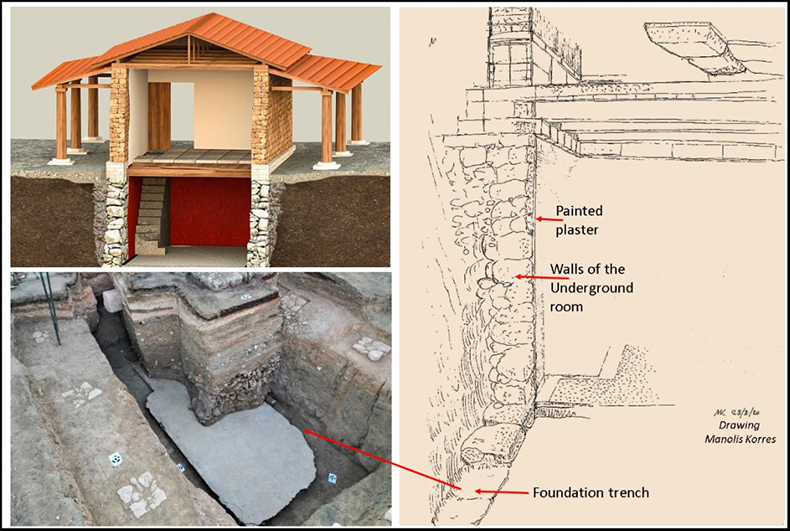
The excavations of the Archaeological Society at Athens (1974-1991) brought to light a Middle Helladic cult of ancestors-healers close to the springs of mineral water on mount Kynortion of Epidaurus. The cult on the site evolved during Mycenaean times into a sanctuary of a goddess of Nature and her male offspring, where it went on without interruption in the first millennium BC. The ancestors were by the time deified as a sacred lineage from the first local king Malos to Koronis, daughter of the king of Lapiths Phlegyas, who mated with Apollo – designated as “Maleatas” (= the one of Malos) because of his affinity with Malos – and gave birth to Asclepius. Until recently, we believed that this cult was transplanted in the mid-sixth century from mount Kynortion to the plain immediately west of it, where Asclepius, while always in connection with his father, prevailed. Recent excavations by the University of Athens (2015- 2022) have shown that the origins of the sanctuary in the plain go back to the 8th and 7th century BC, at the time of the formation of the city-state of Epidaurus. Recent excavations there have shown that in the urban center of the city-state a sanctuary of Asclepius was in function at least since the 4th century BC. Finds however of Mycenaean, Geometric and Archaic pottery from the site show that the roots of the cult go back as well in the city, to much earlier times. In the extra-urban sanctuary of Asclepius, the evidence for the early start of the cult came out in the central part of the sanctuary: a) of the first phase of the sacred well in the area of the Dormitory Hall; b) of the ash altar (for blood sacrifices) in “Building E”; of the first phase of the altar for bloodless sacrifices across (east of) the Tholos, and d) of an early archaic peripteral building with basement hewn in the rock next to and under the Tholos, whose the building was the forerunner.